Personal AI Fleet · Independent exploration · Prototype and active development
My personal life is spread across apps, devices, cloud storage, and years of accumulated notes. Projects have histories in different places. Reminders sit apart from the information that makes them useful. Even planning the day means moving between tools to piece together what needs my attention.
I started this project to explore how AI could help connect those pieces.
The idea is a personal chief of staff called Nexus, supported by a team of specialist agents. Nexus would give me one place to ask for help, understand what is happening, and coordinate work across the different parts of my life.
I began by prototyping that experience. Since then, I’ve been actively building the working system.
Watch the prototype walkthrough on YouTube.
Organizing the system around my life
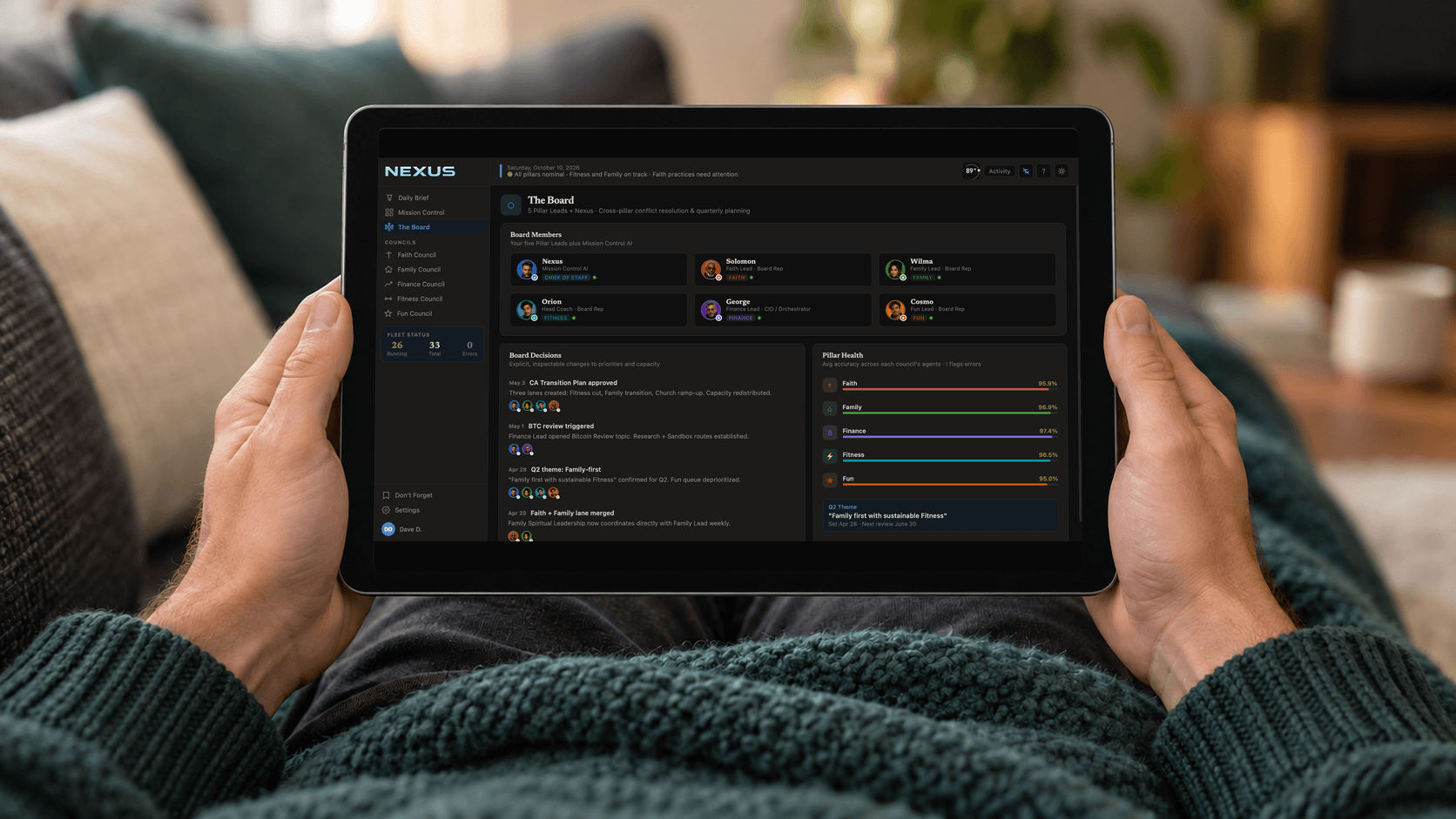
I organized the prototype around five personal priorities: Faith, Family, Finance, Fitness, and Fun.
Each has different needs, information, and rhythms. A fitness agent needs context about training and recovery. An agent helping with family plans needs to understand commitments and ongoing projects. Their responsibilities—and the way they communicate—should reflect those differences.
That led me toward teams of specialists coordinated through Nexus. The design challenge was to make their work feel connected while giving each agent a clear purpose.
The daily brief brings that idea into a familiar routine: pray, plan, and proceed. In the prototype, it gathers reminders, projects, proposed actions, and useful context into a place to begin the day. It reflects a routine I already follow, with information I currently gather across several devices and apps.
Giving memory a continuing role
The memory layer is one of the most personal parts of the project.
I want the system to preserve the context around something over time: why I started it, what I’ve considered, what changed, and what remains unfinished. That context might be scattered across notes, documents, photographs, and previous conversations.
In the prototype, I explored bringing those pieces together as threads. A Jeep project, for example, could connect build notes, photographs, a budget, and milestones. Agents could contribute ideas while preserving the history that gives those ideas meaning.
That same principle shaped the fitness exploration. Training, recovery, nutrition, and schedules become more useful when considered together. The design explores how agents could turn those scattered inputs into a plan I can follow.
These are proposed experiences shown with sample data. The prototype helped me make the relationships visible before implementing the connections behind them.
Making the agents’ work understandable
As agents take on more responsibility, I need to understand what they are doing and where my judgment belongs.
The prototype explores that through an activity panel, visible handoffs, and different levels of autonomy. I can see the intended path from research to a recommendation, including the points where a person should review or approve an action.
The finance workspace made this especially concrete. I modeled it around a trading team, with roles for research, competing perspectives, risk review, execution, and monitoring. The proposed experience makes room for a bull case, a bear case, and a record of how a recommendation developed.
I also explored research-only, partially autonomous, and fully autonomous modes. Those controls express a central design question: how much responsibility am I prepared to give the system, and under what conditions?
The same attention extends to everyday operation. The prototype includes controls for obscuring sensitive information and a settings area for understanding model choices, usage, and cost. A personal system has to be manageable as well as useful.
Using the prototype to define the work
The dashboard gave me a way to explore the broader experience before building every underlying capability.
Its agent roster, activity streams, financial information, and conversations use simulated data or scripted responses. They show how the system could behave. They also let me examine how someone would move between a daily overview, a specific concern, and the details behind a recommendation.
That distinction matters to the build story. The prototype is a design exploration; the working system is developing incrementally.
My initial foundation used OpenClaw, Telegram, and Obsidian. Since then, I’ve switched to Grok Bot while keeping Obsidian as the source of truth for the system’s data. I’ve been slowly building out the team of agents around that foundation.
An autonomous Wheel Strategy trading agent already runs in Alpaca’s paper environment. Its fills are simulated, and no real money is traded. It is a working part of the broader exploration, while the dashboard remains a prototype.
Building outward from Nexus
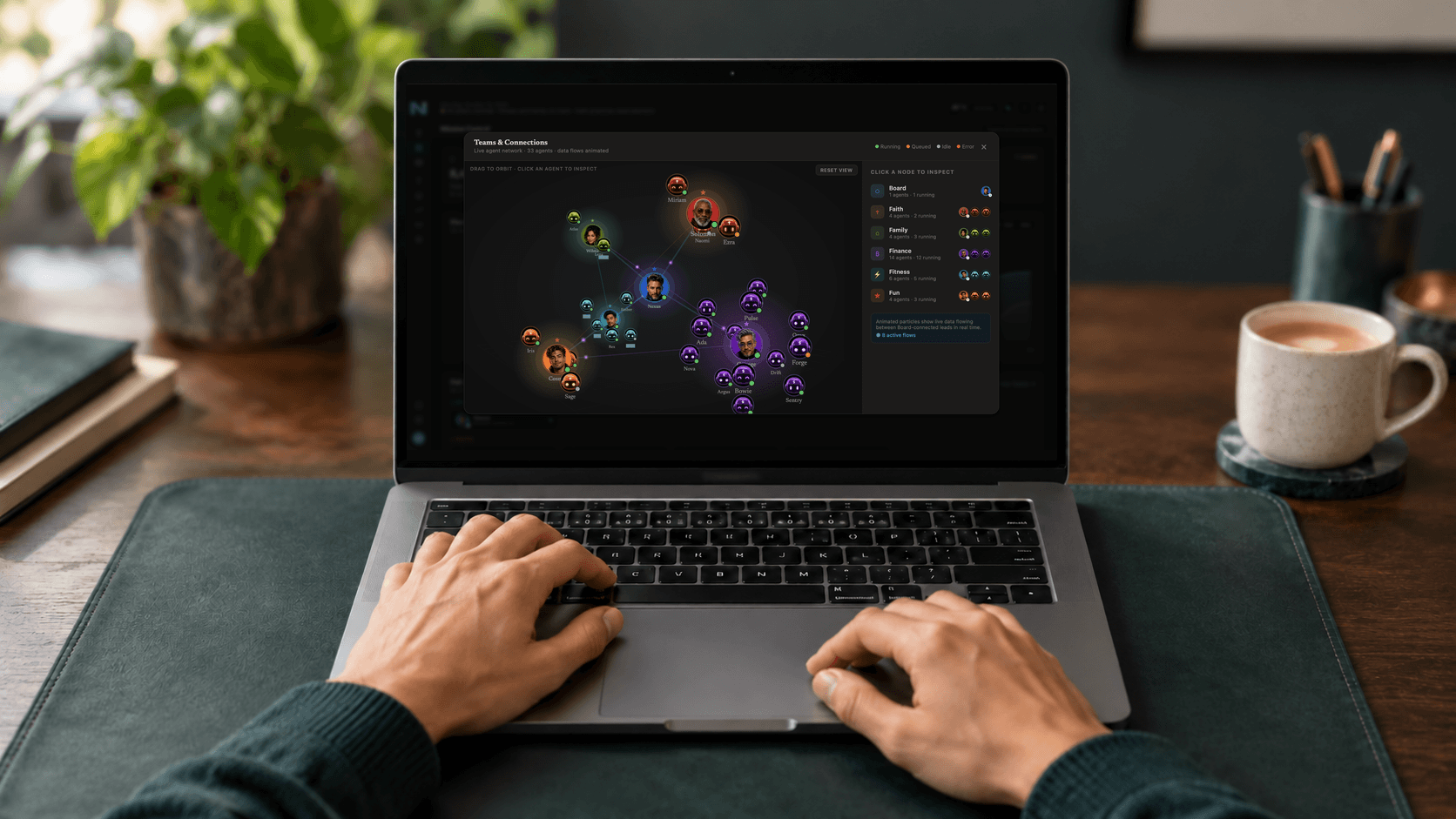
My immediate priority is to make Nexus useful as a chief of staff. Specialist agents can then grow around it with clear responsibilities, shared context, and deliberate handoffs.
The prototype establishes a direction. Building the real system is where I can find out which parts deserve a place in everyday life.
The outcome I’m working toward is practical: less effort reconstructing context, a clearer view of what needs attention, and help that remains connected to my priorities. This project gives me a way to explore those questions through both design and hands-on building.